
Searching Broomfield County Criminal Dockets
For a coming hearing in Broomfield state court, the free Colorado Judicial Branch Docket Search is the natural first stop. Pick Broomfield and the right court type there. Choose a date. Then add at least one more filter. Options include the district, courthouse, division, case number, party, or attorney. A date alone pulls too much. What comes back is a Broomfield hearing schedule. It lists date, time, division, case identity, and an event label. It does not show the complaint, motions, plea paperwork, or sentencing order. For a chronological case history instead, follow the Judicial Branch court-record search route to an authorized real-time register vendor. Remember that vendor data are not the official court record and carry no filed images. A Broomfield County criminal docket search that needs an official disposition, sentence, or pleading must finish with the Clerk of Court, Broomfield Combined Courts.
- Read the Broomfield court name on the citation, summons, or notice before selecting a search system.
- Use Broomfield, a date, and one added filter in the state calendar search.
- Match the Broomfield case number, court, division, and event before relying on the result.
- Use an authorized vendor or request a Broomfield ROA when the full event sequence matters.
- Ask the correct Broomfield clerk for a named filing or certified outcome.
Broomfield County Criminal Docket Fields
The state search form works two ways. With a case number in hand, it supports a narrow Broomfield search. Without one, party mode casts a wider net. A Broomfield case number may break into a four-digit year plus a sequence field, so try both parts if the whole string fails. Party mode also separates individuals from businesses, and attorney mode accepts either a name or a bar number. The courts publish no exact Broomfield short-code pattern. Copy the full number from your court notice exactly as printed rather than reshaping it into a guessed format.
| Field | Use | Important limit |
|---|---|---|
| County and court type | Narrows results to Broomfield state court | Municipal ordinance cases use a separate clerk |
| Date and division | Finds a published Broomfield setting | Date needs at least one added filter |
| Year and sequence | Targets a known Broomfield case number | Use the number printed on the notice |
| Party or attorney | Helps when the Broomfield number is unknown | Common names may return several matters |
If nothing comes back, recheck the spelling. Also recheck the individual-versus-business choice on the form. Then ask whether the Broomfield charge is municipal rather than state. The Municipal Court clerk takes calls at 720-887-2100. Email works too, at courtaccess@broomfield.org. A blank statewide calendar does not mean no criminal case exists.
Inside a Broomfield County Criminal Docket
The Broomfield criminal Register of Action, or ROA, walks through a case in order. It lists the court and division first. Filing and status dates follow, along with counsel roles, charges, settings, minute orders, plea, disposition, and sentence. A minute order is simply a brief court-entered record of a ruling or event. Some financial entries are open to the public. They may include fines, costs, restitution, or a balance. Protected identifiers and restricted material are withheld from the Broomfield ROA.
| Case identity | Case number, court, Broomfield location, division, filed date, and status |
|---|---|
| Charges | Charge count in Broomfield, description, cited law, classification, and disposition by count |
| Bond and settings | Public Broomfield bond terms, appearances, hearings, trials, and resets |
| Orders and outcome | Broomfield minute orders, plea, disposition, sentence, appeal, or reopen activity |
| Filed documents | Not supplied by the vendor; request the named item from the Broomfield clerk |
Trust the full official case number, the one in the court caption. Do not guess a Broomfield format like YYYY-CR-#####, because no official local codebook backs that pattern.
Broomfield County Criminal Docket Terms
Read the full event text, not just an unexplained code. Colorado and Broomfield materials describe the procedural terms. But they publish no local ICON or ROA abbreviation key. Walk the entries in date order. That keeps an old setting from looking like the current status. It also stops a dismissal on one count from being mistaken for the outcome of the whole Broomfield case.
- Arraignment
- The stage at which a plea is received or scheduled.
- Continuance or reset
- A setting moved to a later date; the prior event remains in the history.
- Disposition
- The procedural or merits outcome for a count or case.
- Deferred judgment or sentence
- An outcome delayed while stated conditions are addressed.
- Failure to appear
- A missed required appearance that may lead to added cost or warrant action.
Pending, guilty, not guilty, dismissed, closed, appealed, and sealed each mark a different state of a case. When a compact code stays unclear, ask the clerk for the ROA or the order behind it.
How a Criminal Case Moves
A Broomfield County criminal docket opens with a complaint or information. The docket lists the charge counts. Early entries often record an advisal, first appearance, and bond decision. Arraignment is the plea stage. From there, discovery filings, motions, responses, and minute orders build the record. Pretrial conferences plus continuances show how the case gets prepped and scheduled.
Docket flow: Filing → Arraignment → Pretrial → Plea or Trial → Disposition → Sentencing
Real cases rarely follow a clean line. Resets stay visible on the docket. After disposition, the Broomfield criminal docket may add compliance reviews, a failure-to-appear or warrant entry, an appeal, or sealing activity. Read the latest dated entry together with the current calendar before any court appearance.
Broomfield County Criminal Document Requests
State record requests run through one standard form. You can ask for a disposition or sentence order. A protection order, a ticket, the ROA, certification, or any document you can name also works. Give the case number plus the document title and date if you have them. The clerk's published target is three business days, though archive pulls and redaction work can stretch that. Certified or exemplified copies cost $20 per document on top of copying. A nonparty name search with an ROA runs $5.
Prefer a different channel? Email BroomfieldRecordsRequest@judicial.state.co.us or call 303-464-5020. You can also mail the printable form or visit the Combined Courts counter at 17 Descombes Drive. Municipal cases go a separate route. The city clerk, the municipal records form, email, phone, mail, or the counter all work. The clerk offers no confirmed public terminal. Phone ahead if terminal access matters to your docket search. Active-case discovery uses the municipal discovery form. It is limited to the defendant, counsel of record, or a juvenile defendant's parent or guardian. Discovery is not the same as a public request for closed-case court records.
Courts That Hold Criminal Dockets
The court named on the paperwork tells you who holds the file. Felonies belong to Broomfield County District Court. Broomfield County Court handles state misdemeanors, state traffic matters, and preliminary-level cases. The Combined Courts clerk keeps both files. Broomfield Municipal Court is separate. It hears city ordinance misdemeanors along with traffic, parking, animal, and code cases. Its own clerk maintains those records. All three courts sit at the same address.
| Court | Criminal docket | Custodian |
|---|---|---|
| Broomfield County District Court | Felonies and related proceedings | Combined Courts clerk |
| Broomfield County Court | State misdemeanors and traffic | Combined Courts clerk |
| Broomfield Municipal Court | City ordinance cases | Municipal clerk |
A Broomfield police citation alone won't tell you where the case lives. Check who filed the charge: the State of Colorado or the City of Broomfield. That single line decides your docket search, the clerk you call, and which record rules apply.
Broomfield County Criminal Filing Numbers
Broomfield's criminal caseload shows up in branch-wide statistics. The FY2024 Colorado Judicial Branch statistical report counts 505 District Court criminal filings and 563 terminations at the Broomfield location. Those are filing figures only. They say nothing about pending cases or court delay, and they leave the municipal docket out entirely.
Broomfield's numbers sit inside the 17th Judicial District. That district pairs Adams with Broomfield and ranks third in Colorado by caseload volume. So the Broomfield criminal docket is local in place but part of a far bigger system.
Broomfield County Criminal Jury Demand
Municipal defendants who plead not guilty face a deadline. A written jury demand plus the $25 fee must land within 21 calendar days of that plea. So must an indigency waiver motion. The official form lets a defendant ask for three, four, five, or six jurors. That filing shows up in the municipal case activity. It has nothing to do with District Court felony procedure. For state court records, turn to the Chief Justice directives index. It holds the official access and fee directives.
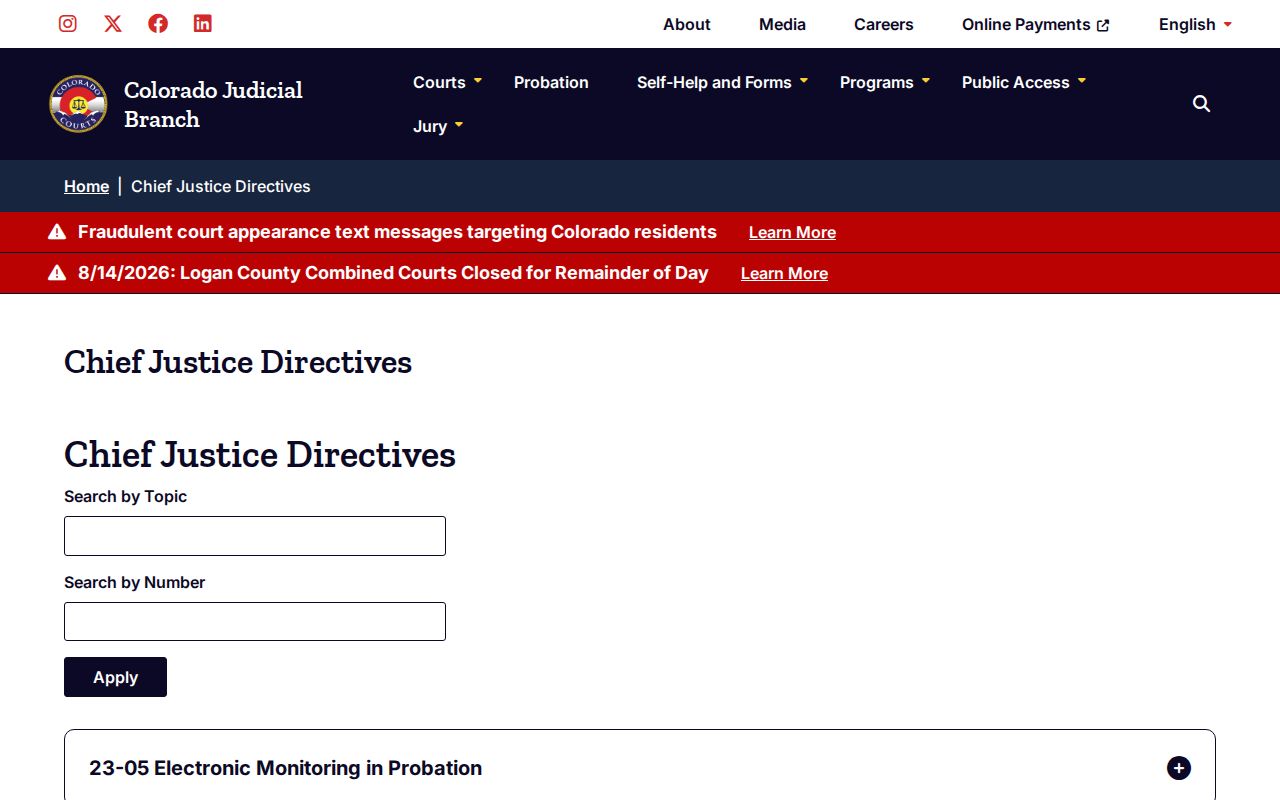
Access and fee rules can change by amendment. The directive index is the dependable way to reach the current text.
Sealed Dockets and Public Access
Public access has limits in the Broomfield County criminal docket. Sealed files and suppressed cases may stay offline. Juvenile matters and documents with confidential details may require identification. A public calendar can drop a protected matter. It may show only partial data. So a missing remote result proves nothing about any person or case.
Key access rules:
Colorado Rule of Criminal Procedure 55.1 requires a written closure order that identifies the protected interest, probable harm, lack of a less restrictive option, and the balance against public access.
Chief Justice Directive 05-01 defines public, remote, facility-only, excluded, and compiled-data access to court records.
Colorado Criminal Justice Records Act provisions govern criminal justice custodian decisions and limits, including municipal records.
Ask the right clerk what exists: a redacted copy, party access, an identity check, or a court order. Sealing requests that qualify should use current Judicial Branch forms plus the law fitting that case. A disposition label by itself never establishes eligibility.